Home

Meet John T-800

Useful assistance.
Accountable expertise.

John is the assistance layer in ConnectedSpine. Its role is to organize authorized context and support professional review.

Follow the knowledge journey

The complete explanation

From teaching
to a reviewable suggestion.

The word “learning” describes a governed knowledge process here. It does not mean patient records automatically train a model.

Illustrative knowledge journey

How John learns and assists

Follow the path from professional contribution to clinician-reviewed assistance.

Teaching clinician

Contribute expertise

Structured professional teaching

1 / 6

Governed knowledge retrieval is not automatic model training. Patient records do not automatically become teaching material, and suggestions do not become signed clinical decisions.

Read every step
  1. Teaching clinician: Contribute expertise. Structured professional teaching.
  2. Clinical authority: Review and approve. An eligible approved version.
  3. Release authority: Release with defined scope. Knowledge requiring separate Care activation.
  4. Authorized clinician: Request permitted assistance. Selected context, assistance-purpose permission and an explicit request.
  5. John: Prepare assistance. Suggestions with sources and limitations.
  6. Clinician: Review and decide. A professional decision; release remains explicit.
Look closer at each part.

Each transition has a purpose and a responsible participant.

Voice, music & captions
Read transcript

Professional teaching begins with a focused question. Open the assigned teaching and its source-defined topic. Draft your contribution with the reasoning that matters. Review the saved answer and its source context. Explicitly request a review when it is ready. Draft, saved, submitted, and approved remain different states. Patient records do not automatically become teaching material.

Teaching · Illustrative workflow

Structured professional teaching

Contribute expertise in a form that can be reviewed and clarified.

Teaching clinician

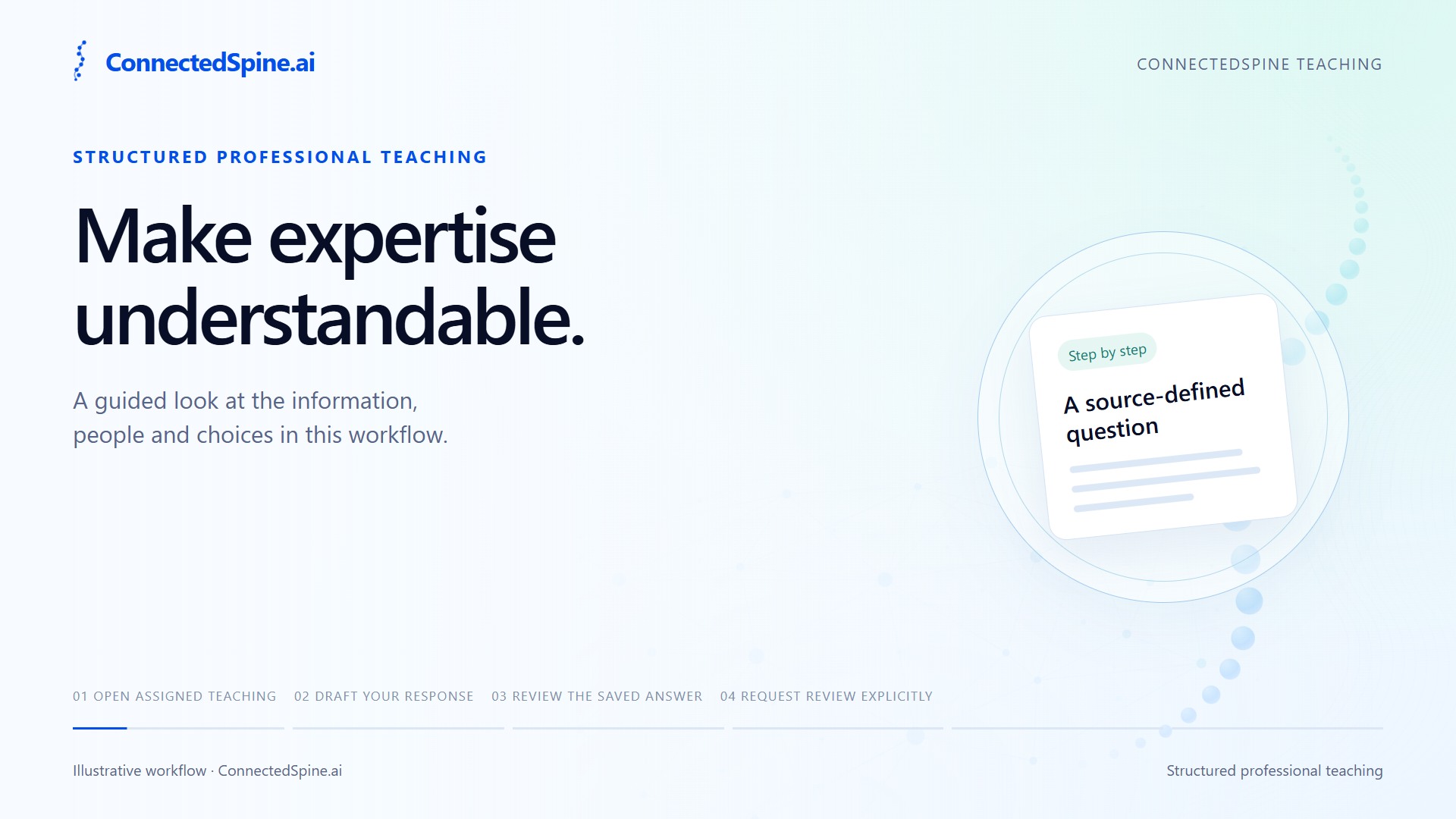
Open assigned teaching

A source-defined question

1 / 4

Draft, saved, submitted and approved are different states. Patient records do not automatically become teaching material.

Read every step
  1. Teaching clinician: Open assigned teaching. A source-defined question.
  2. Teaching clinician: Draft your response. Professional contribution.
  3. Teaching clinician: Review the saved answer. Acknowledged source answer.
  4. Teaching clinician: Request review explicitly. Review requested.
Voice, music & captions
Read transcript

Useful clarification stays connected to the teaching it explains. Read the review questions tied to your answer. Respond to those specific questions. Review the complete clarification before continuing. Explicitly request the next review. The original answer remains part of the history. Clarification does not silently approve knowledge for use.

Teaching · Illustrative workflow

Connected clarification

Keep follow-up questions connected to the teaching they clarify.

Teaching clinician

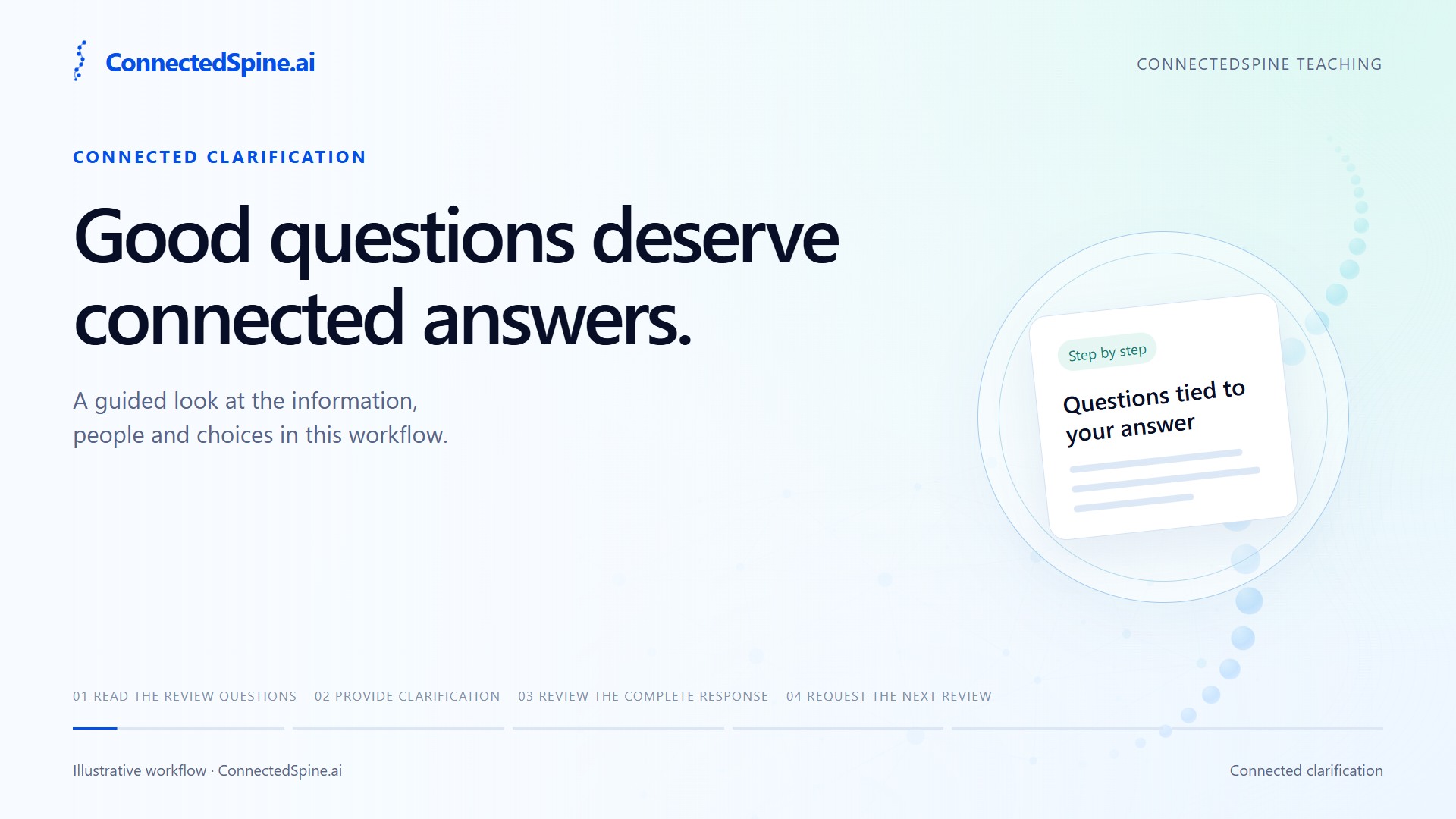
Read the review questions

Questions tied to your answer

1 / 4

Clarification does not silently replace the original answer or approve knowledge for use.

Read every step
  1. Teaching clinician: Read the review questions. Questions tied to your answer.
  2. Teaching clinician: Provide clarification. Responses to the exact questions.
  3. Teaching clinician: Review the complete response. Clarification to check.
  4. Teaching clinician: Request the next review. A new explicit review request.
Voice, music & captions
Read transcript

Professional judgment stays visible in teaching decisions. Inspect John's proposed understanding of the contribution. Check the sources, uncertainty, and limitations. Choose to approve, edit, reject, or defer. Retain the decision with the exact source version. Only an eligible explicit approval creates an approved version. Other decisions keep their own states.

Teaching · Illustrative workflow

Professional teaching decisions

Review John’s interpretation and retain your own decision alongside it.

Teaching clinician

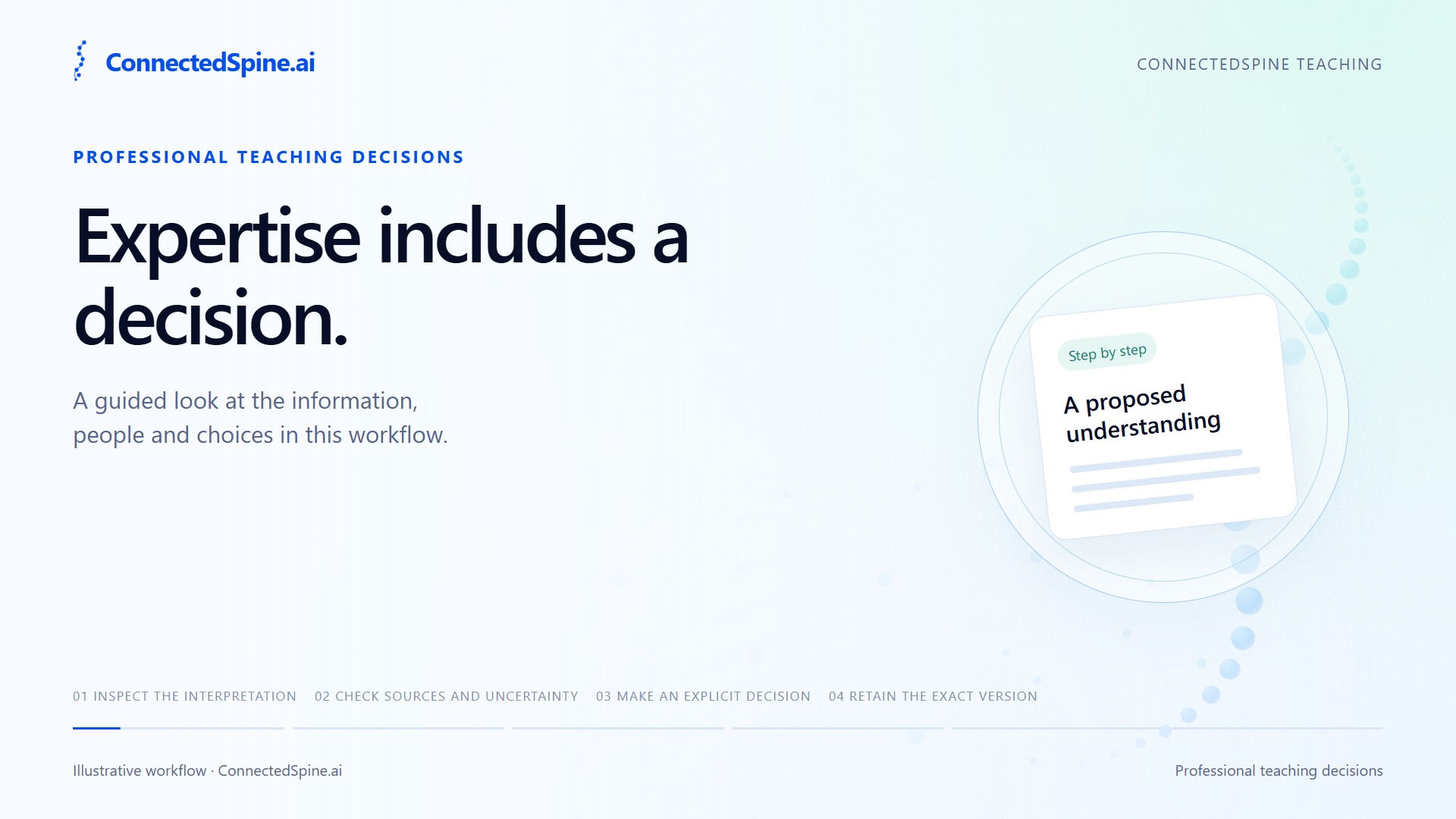
Inspect the interpretation

A proposed understanding

1 / 4

Only an eligible explicit approval creates an approved version. Rejected or deferred items retain those states.

Read every step
  1. Teaching clinician: Inspect the interpretation. A proposed understanding.
  2. Teaching clinician: Check sources and uncertainty. Evidence and limitations.
  3. Teaching clinician: Make an explicit decision. Approve, edit, reject or defer.
  4. Teaching workspace: Retain the exact version. Decision and source history.
Voice, music & captions
Read transcript

Knowledge release follows a deliberate, accountable path. Assemble the approved versions that are eligible for release. Clinical authority reviews the scope and constraints. Release authority publishes the exact authorized version. Care validation and activation happen separately. Teaching publication does not activate Care. The release carries eligible knowledge, with patient records and private drafts excluded.

Governed release · Separate activation

Governed knowledge release

Move eligible knowledge through clinical approval and a controlled release process.

Release preparation

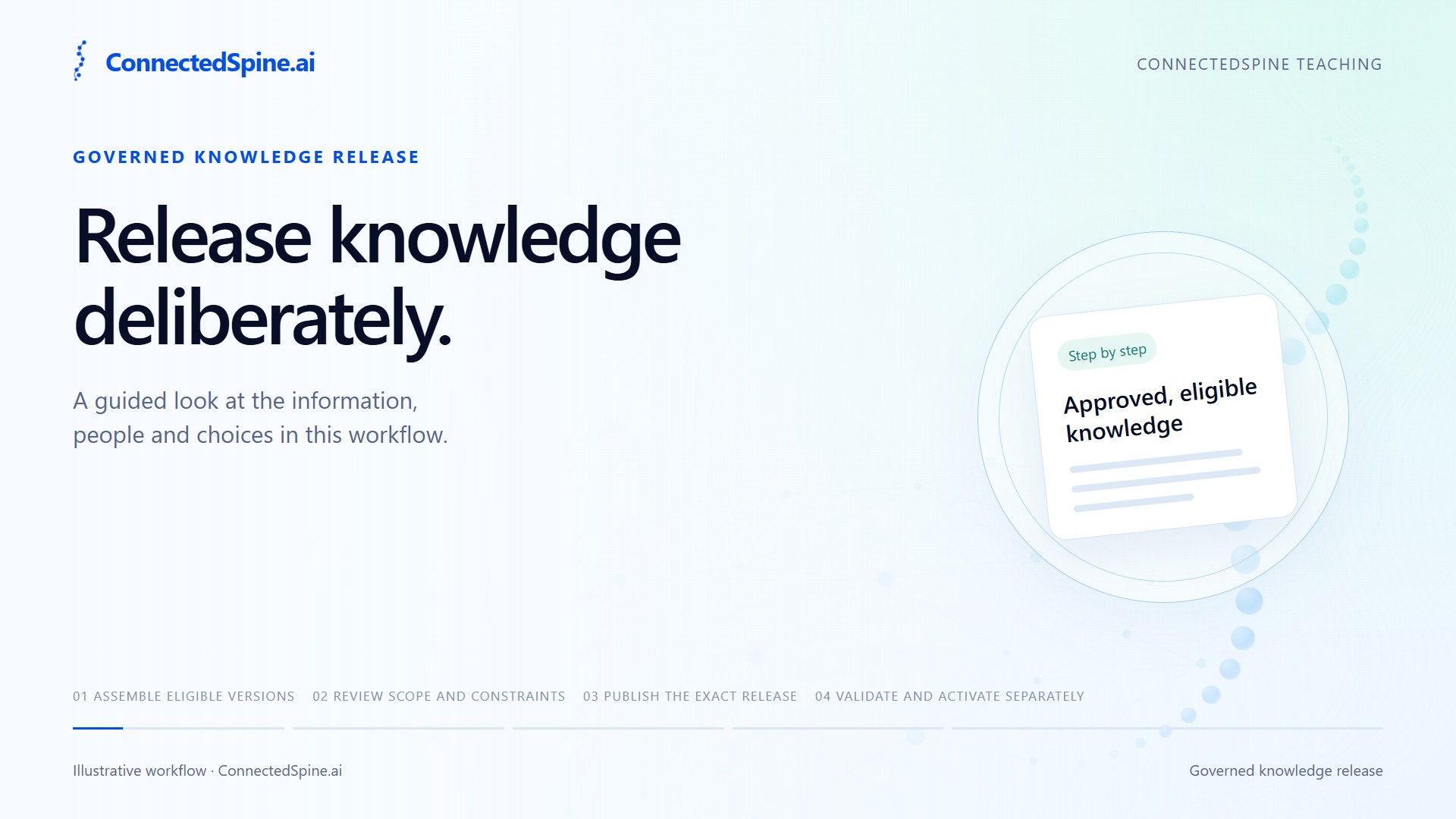
Assemble eligible versions

Approved, eligible knowledge

1 / 4

Teaching publication does not activate Care. Patient records, raw answers and private drafts stay outside the minimized release.

Read every step
  1. Release preparation: Assemble eligible versions. Approved, eligible knowledge.
  2. Clinical authority: Review scope and constraints. Clinical release review.
  3. Release authority: Publish the exact release. An authorized published version.
  4. Care release process: Validate and activate separately. A separate Care activation gate.
Voice, music & captions
Read transcript

John supports professional review with context and sources. An authorized clinician explicitly requests assistance for permitted context. John finds relevant, eligible released knowledge. The suggestion includes sources and limitations to examine. The clinician evaluates the suggestion and makes the decision. Assistance remains advisory. Diagnosis, prescribing, signatures, and patient release remain professional responsibilities.

ConnectedSpine Care

How John assists

Bring authorized case context and eligible knowledge into suggestions for professional review.

Authorized clinician

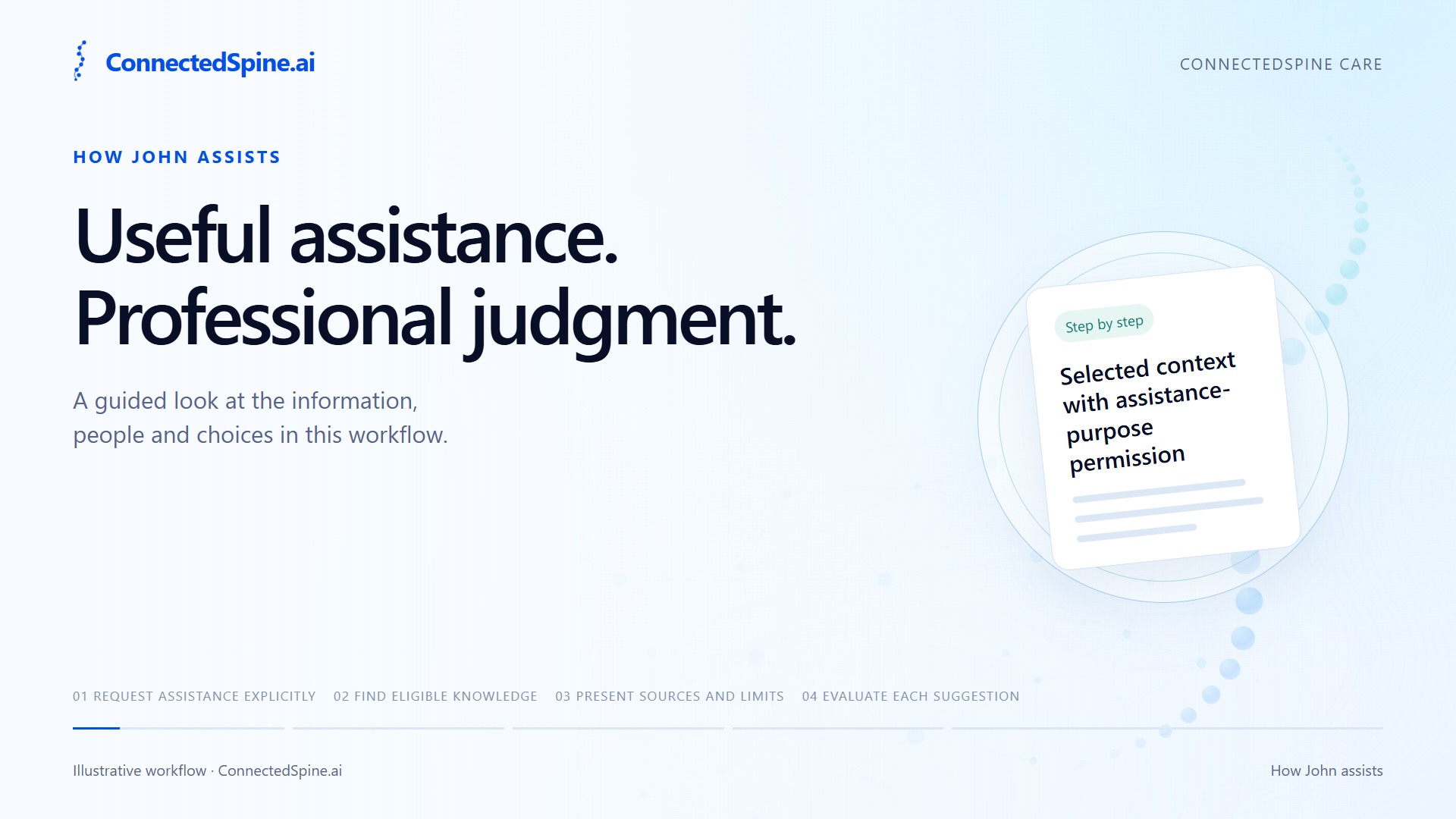
Request assistance explicitly

Selected context with assistance-purpose permission

1 / 4

Assistance is advisory. It does not independently diagnose, prescribe, order, sign or release information.

Read every step
  1. Authorized clinician: Request assistance explicitly. Selected context with assistance-purpose permission.
  2. John: Find eligible knowledge. Relevant, released knowledge.
  3. John: Present sources and limits. A suggestion to review.
  4. Clinician: Evaluate each suggestion. Professional review and decision.

Sources remain visible

Context is not certainty.

Missing information, limitations and conflicting evidence should remain part of professional review. A prepared suggestion is not a verified clinical conclusion.

Decisions remain human

Assistance is advisory.

John does not independently diagnose, prescribe, order, sign or release patient information. It cannot recommend a payer outcome.

A clear clinical boundary

Imaging interpretation is not available.

John does not read or interpret MRI or X-ray images. Clinical imaging interpretation remains with qualified professionals.

Understand the boundaries

Information has a purpose.

Explore permissions