Care. Knowledge. Connection.
A clearer path,
together.
Every care journey brings people, information and decisions together. Follow the choices and workflows that give each connection a purpose.
Read transcript
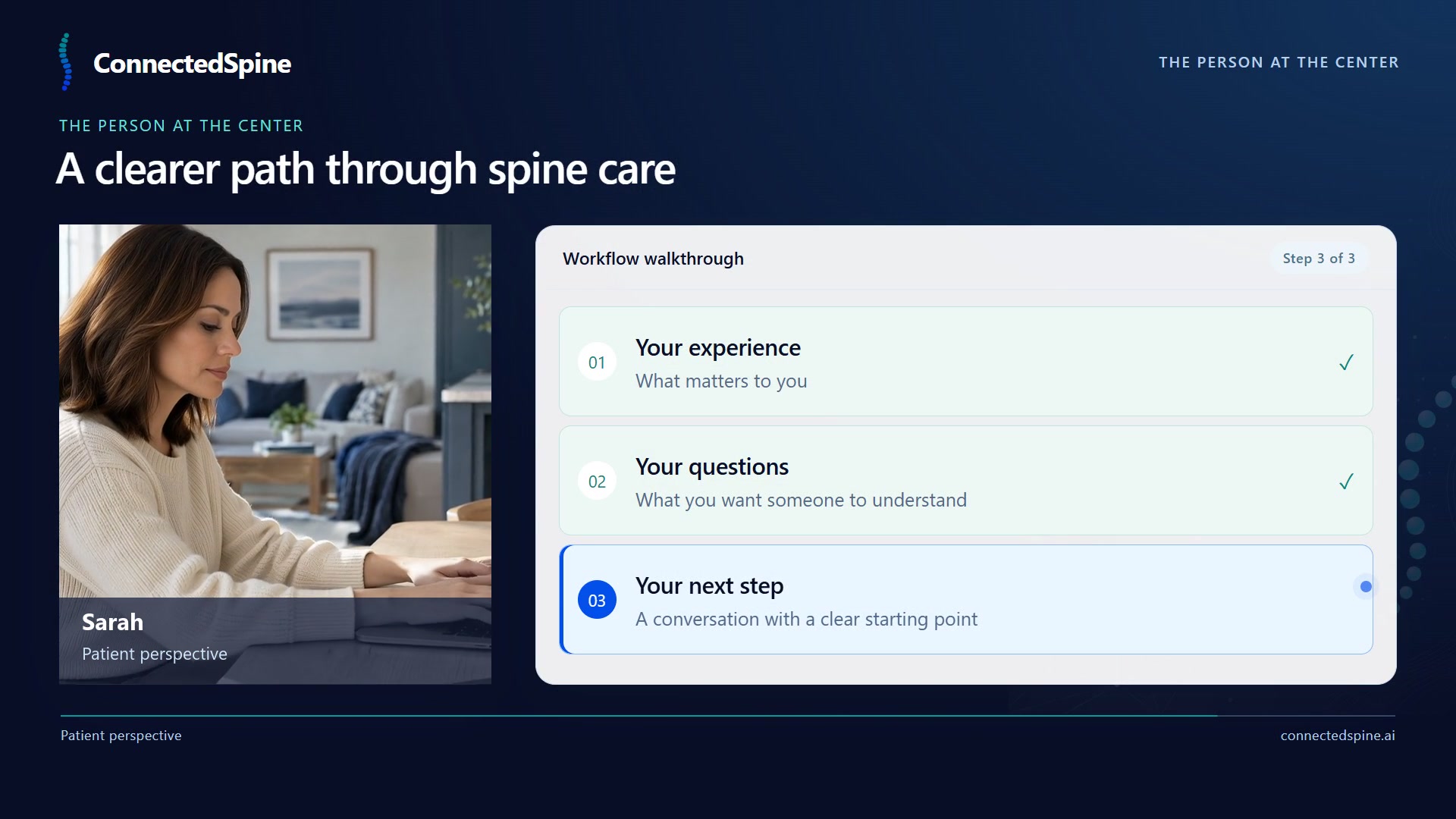
My question is simple. What do you need to know about me, and what happens next? A care conversation begins with a person: what matters to them, and what they want someone to understand. Meet Sarah, and the people helping her prepare for care. ConnectedSpine brings their work together through Care, Teaching, and assistance from John. I start with my concerns, my everyday goals, and the questions I do not want to forget. Sarah brings together relevant history and medicines, then checks her answers before submitting her assessment. Her own words give the conversation a starting point. When she is ready, she chooses who to share them with. Documents and records can add useful context to Sarah's story. She can organize documents, check their source, and choose their sharing scope. Where a supported connection is available, a separate request brings back available records. The coverage and request status help her see what is there, and what may still be missing. Here's the assessment I want Dr Chen to see. I check what I am sharing, why, and who will receive it. Sarah sees those choices together, selects the eligible clinician, and confirms. If someone new joins her care, sharing with that person is another deliberate choice. I begin with Sarah's original answers. I want to understand her perspective before developing my own interpretation. Dr Chen follows the source, develops a professional draft, and prepares wording for Sarah to read after review and release. When I need assistance, I select the permitted context and ask John. I look at what supports the suggestion, what challenges it, and what is missing. John uses the eligible knowledge selected for that request. Dr Chen considers the suggestion, questions it, and edits or rejects it as needed. The source stays visible, and the professional decision remains hers. I write my clinical result and prepare the plan: goals, responsibilities, and next steps. Then I review the version, complete the required signatures, and release it. Now I have the information my clinician wants me to use. I can return to that released version as I prepare for what comes next. A referral starts with a clinician's recommendation. Sarah reviews the destination and the information to share. The team follows its progress and keeps the coordination history together. External confirmation is a separate step. I review Sarah's scheduling preference and propose an available time, using the details my role allows. Sarah reviews and accepts the proposal. This internal reservation keeps her choice visible; external appointment confirmation remains a separate step. Before I send a question, I check who is in the conversation. Named participants make the audience clear. Sarah reviews her message, then sends it. Patient conversations and staff discussions have their own space. My journal is a place for my own observations. I can keep an entry private, share it with selected clinicians, or choose specific fields for a question to John. Sarah checks the selected fields, grants permission for that use, and confirms the attachment. Then she saves her question and explicitly requests assistance. Only that chosen context goes with this request. She can review the generated wording before deciding what, if anything, to use. Follow-up brings Sarah back to her released plan. She opens the task, checks her response, and submits it to the stated clinicians. Dr Chen records an acknowledgment, keeping Sarah's response and the review action connected. My review starts with a defined request and the information permitted for that purpose. I can see what I am being asked to review. The team selects released documentation and confirms the recipient and purpose. Marcus receives a focused packet; Sarah's journal and the clinician's working drafts remain outside. If I need more information, I can ask for a specific supplement. The clinician prepares the response, signs the reviewed version, and releases it separately. Each determination stays with an authorized human reviewer and its supporting record. If an appeal is needed, it goes to a separate, independent reviewer. The request, the response, and the people responsible remain connected throughout the review. In my organization role, I look across programs, locations, and staff responsibilities. I can review access, prepare an invitation, and find the right professional in the directory. Teams work from role-specific views and reports that retain their sources. Export permissions stay explicit. Platform teams look after governed settings and history. Together, these workspaces help people understand where the work belongs and which responsibilities are theirs. Professional expertise has its own place in this story: ConnectedSpine Teaching. Teaching gives my experience a structured place to be examined, clarified, and reviewed. I start with an assigned question. I explain my reasoning, the context where it applies, and its limits. Then I read back the answer I have saved. Amina acknowledges that source and explicitly requests review. The question and contribution stay connected, so the next person examining the knowledge can understand where it began and what the clinician actually said. A useful review asks me to be more precise. I can answer a focused clarification while keeping the original contribution in view. Amina checks the complete response, then requests the next review. Each clarification stays connected to the question it answers. The conversation gains detail without losing its original source. I inspect John's proposed understanding, its sources, and its uncertainty. I can approve it, make permitted edits, reject it, or defer a decision. An explicit, eligible approval creates an approved version. Amina can return to the original proposal, her edits, and the decision behind it. That history gives later reviewers something concrete to examine when the knowledge is reconsidered. Approved expertise follows a deliberate path to use. Eligible versions are assembled for clinical review, with their scope and limits in view. Authorized release teams publish the exact version. Care then performs its own validation and activation checks. Sources and decisions travel with the permitted knowledge, so it can be reviewed, updated, or withdrawn responsibly. Sarah's patient record remains separate from this teaching process. I know what I shared, who is involved, and the next step my clinician released. Your experience at the center. Professional judgment respected. Knowledge with a source, and a clear purpose for every connection. ConnectedSpine. A clearer path through spine care. Explore more at connectedspine dot ai.
A story worth sharing.
Send the film to someone who is part of the care conversation.
Explore the film
Choose a moment.
Watch from the beginning, or jump to the workflow that matters to you.
- 01A person before a process0:00
- 02Meet ConnectedSpine0:14
- 03Prepare in your own words0:25
- 04Bring your documents together0:46
- 05Choose who receives your assessment1:08
- 06Review the original information1:28
- 07John assists. The clinician decides.1:45
- 08A reviewed result and care plan2:13
- 09Coordinate a referral2:36
- 10Review an appointment proposal2:51
- 11Know who is in the conversation3:09
- 12Your journal and a question for John3:25
- 13Follow up on the released plan3:58
- 14A focused packet for payer review4:14
- 15Supplements, review and appeal4:39
- 16Organization and platform workspaces5:08
- 17A place for professional expertise5:41
- 18Contribute and request review5:55
- 19Clarify the meaning6:21
- 20Review and retain a version6:47
- 21Publish knowledge with a clear purpose7:16
- 22Choices you can understand7:45
- 23Your next step8:01
Keep exploring
Find your next step.
Look more closely at the workspace and responsibilities that connect with yours.